2025 Highlights

Here is our final newsletter for 2025 where we focus on our achievements. Special thanks to our authors and editors!
Merry Xmas and a Happy New Year from all of us!
    

We are delighted to announce that Cochrane Gynaecology and Fertility (CGF) will celebrate its 30th anniversary in 2026 — and we warmly invite all our authors, editors, and contributors to join us for this special milestone event.
📍 Venue:
Rooms at the Royal College of Obstetricians and Gynaecologists (RCOG), London
📆 Date:
Saturday, 4 July 2026
🕒 Full programme and timings to follow
This celebration will take place the day before the start of ESHRE 2026, making it easy for those travelling to London for the congress to attend both events.
The day will be an opportunity to:
- Reflect on 30 years of rigorous evidence synthesis in reproductive health
- Celebrate the achievements of our global CGF community
- Connect with colleagues, collaborators, and friends
- Look ahead to the next era of Cochrane Gynaecology and Fertility
A formal invitation and registration details will follow early next year — but for now, please save the date.
We hope to see as many of you there as possible as we mark this important anniversary together.

Published reviews and updates

Acupuncture for polycystic ovary syndrome 
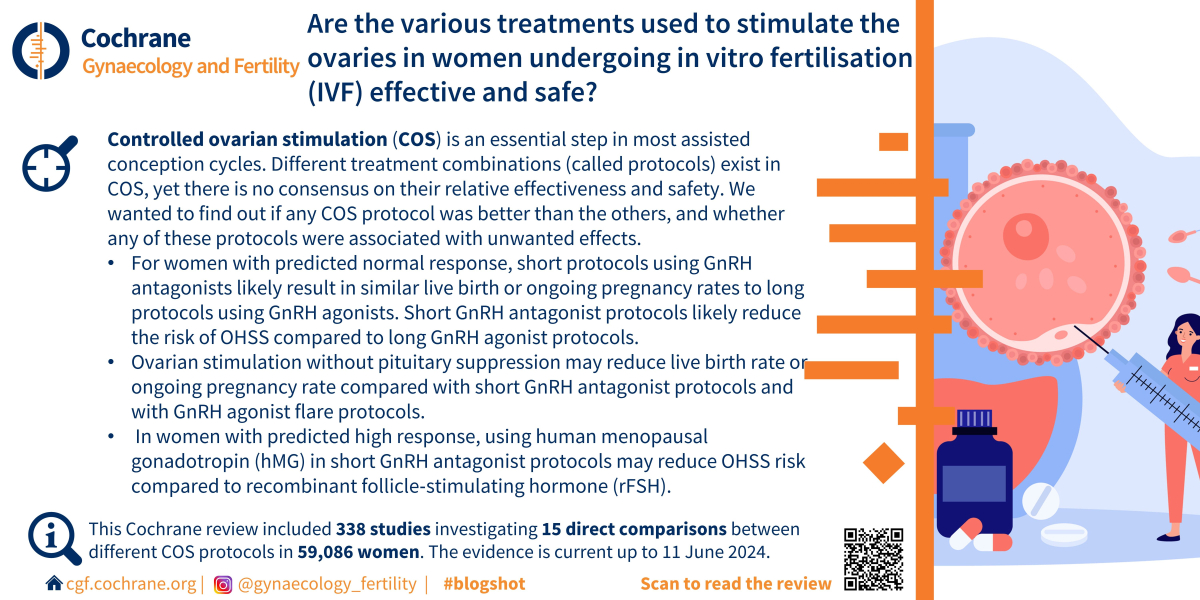
Controlled ovarian stimulation protocols for assisted reproduction: a network meta‐analysis  


Cycle regimens for endometrial preparation prior to frozen embryo transfer 
Cyproterone acetate for hirsutism
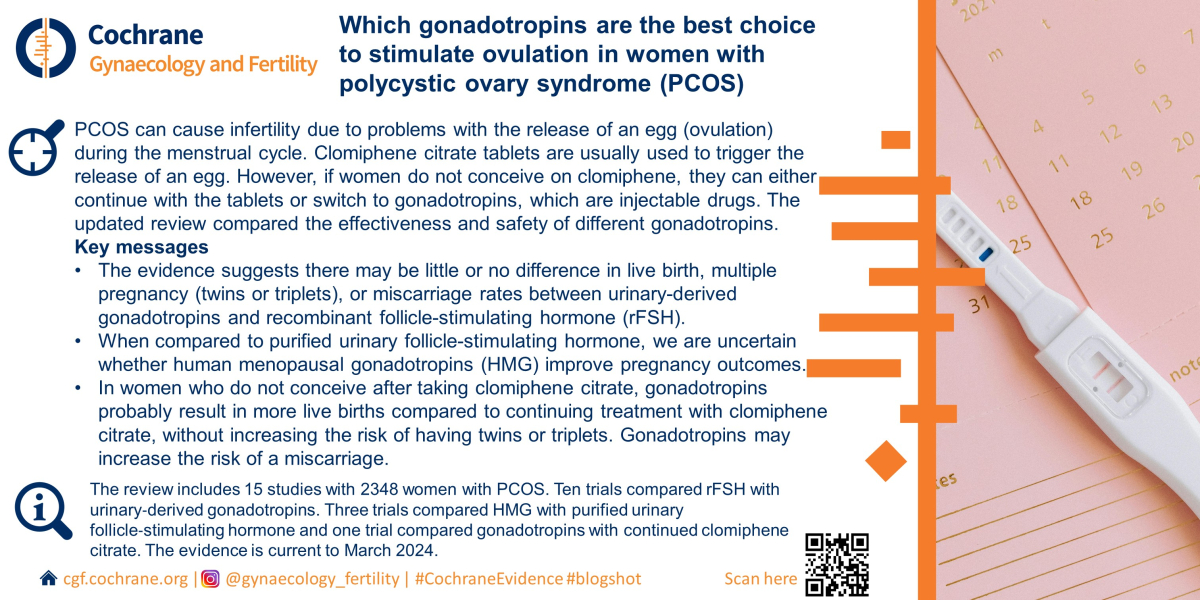
Gonadotrophins for ovulation induction in women with polycystic ovary syndrome 

Gonadotropin‐releasing hormone agonist protocols for pituitary suppression in assisted reproduction  
Gonadotropin-releasing hormone (GnRH) analogues for premenstrual syndrome (PMS) 
Hormone therapy in postmenopausal women and risk of endometrial hyperplasia or endometrial cancer 
Interventions for fertility preservation in women with cancer undergoing chemotherapy 
In vitro maturation in subfertile women with polycystic ovarian syndrome undergoing assisted reproduction
Long‐term hormone therapy for perimenopausal and postmenopausal women 
Perioperative interventions in pelvic organ prolapse surgery
Preoperative medical therapy before surgery for uterine fibroids 
Progestagens for pain symptoms associated with endometriosis
Septum resection for women of reproductive age with a septate uterus
Synchronised approach for intrauterine insemination in subfertile couples 
Vasodilators for women undergoing fertility treatment

New protocols
Androgens for genitourinary and vasomotor symptoms associated with menopause 
Interventions in addition to broad-spectrum intravenous antibiotic therapy for the treatment of radiologically proven tubo-ovarian abscess 
Pelvic floor muscle therapy for sexual dysfunction in gynaecological cancer survivors

WHO Fertility Guideline published 28th November 2025

The World Health Organization (WHO) has published  its first-ever global guideline for the prevention, diagnosis and treatment of infertility. The guideline was developed with the help of Cochrane Canada and includes 18 Cochrane Reviews.  The Chair was Dr Richard Kennedy with Professor Cindy Farquhar the vice-chair. 

The guideline provides guidance on steps for the effective clinical management of infertility and includes 40 recommendations that seek to strengthen the prevention, diagnosis, and treatment of infertility. It promotes cost-effective options at every stage, while advocating for the integration of fertility care into national health strategies, services and financing.

It also calls for increased investment in prevention, including information on fertility and infertility, factors such as age, in schools, primary health care and reproductive health facilities.

It stresses the need to tackle leading risk factors for infertility, including untreated sexually transmitted infections and tobacco use. Lifestyle interventions – such as healthy diet, physical activity, and tobacco cessation – are recommended for individuals and couples planning or attempting pregnancy. Informing people about fertility and infertility early can assist them in making reproductive plans.

The guideline outlines clinical pathways to diagnose common biological causes of male and female infertility. Considering the findings from clinical tests as well as patient preferences, it provides guidance on how to progressively advance treatment options from simpler management strategies – where clinicians first provide advice on fertile periods and fertility promotion without active treatment – to more complex treatment courses such as intrauterine insemination or IVF.

Recognizing the emotional toll of infertility, which can lead to depression, anxiety and feelings of social isolation, the guideline emphasizes the need to ensure ongoing access to psychosocial support for all those affected.

While comprehensive, the guideline acknowledges current gaps in evidence as well as areas for future research and additional recommendations. Upcoming editions of the guideline are expected to cover issues such as fertility preservation, third-party reproduction, and the impact of pre-existing medical conditions.

The guideline can be found here

Melbourne Satellite for Cochrane Gynaecology and Fertility Group
We are pleased to announce that a Melbourne-based satellite for the Cochrane Gynaecology and Fertility Group was established earlier this year in June. This satellite will be led by Coordinating Editor Sarah Lensen, with support from Managing Editor Michelle Steeper.

The Melbourne team will assume responsibility for the management of Cochrane reviews focusing on IVF add-ons (or optional extras).
Sarah LensenMichelle Steeper


New resource: Evidence-based IVF website
We’re excited to announce that the Evidence-based IVF resource was launched in April 2025. Evidence-based IVF is a new online patient resource developed in collaboration with Cochrane. It provides clear, up-to-date, evidence-based information to help patients understand their IVF treatment options.
Evidence-based IVF is an independent, unbiased resource focused on IVF “optional extras.” It offers detailed insights into their effectiveness, safety, costs, and other considerations, empowering patients to make informed decisions about their fertility care.
Led by Co-ordinating Editor Dr Sarah Lensen and based at the University of Melbourne, the project is independent and not affiliated with any IVF clinics or commercial companies. This ensures that all recommendations are grounded solely in the latest research and evidence.
The website continuously reviews and summarises the newest studies, making complex information accessible and actionable for patients.

Explore the Evidence-based IVF website here

Meetings

ESHRE 41st Annual Meeting 29 June – 2 July, Paris


Cochrane Leadership Meeting 29-30 October, Lisbon

Vanessa, Madelon, and Elena attended the Cochrane Leadership Meeting in Lisbon. We had the opportunity to meet with colleagues from our thematic group, and members of other Cochrane groups and Cochrane Central.

Editorial

Position statement on artificial intelligence (AI) use in evidence synthesis
Cochrane, the Campbell Collaboration, JBI and the Collaboration for Environmental Evidence 2025 published a joint statement on AI use in evidence synthesis. Since November, all Cochrane reviews contain a heading “Disclosure of artificial intelligence use”. An example text that could be used under the heading has been published in the position statement.

Updated CGF guidance document
In September 2025, we published an updated version of CGF Guidance for protocols and new reviews using Risk of Bias 1.0 or Risk of Bias 2 which can be found on our resources page.

If you have any questions, please contact Helen or Elena (h.nagels@auckland.ac.nz | e.b.kostova@amsterdamumc.nl) or Cochrane Support: support@cochrane.org.
Follow us on bluesky